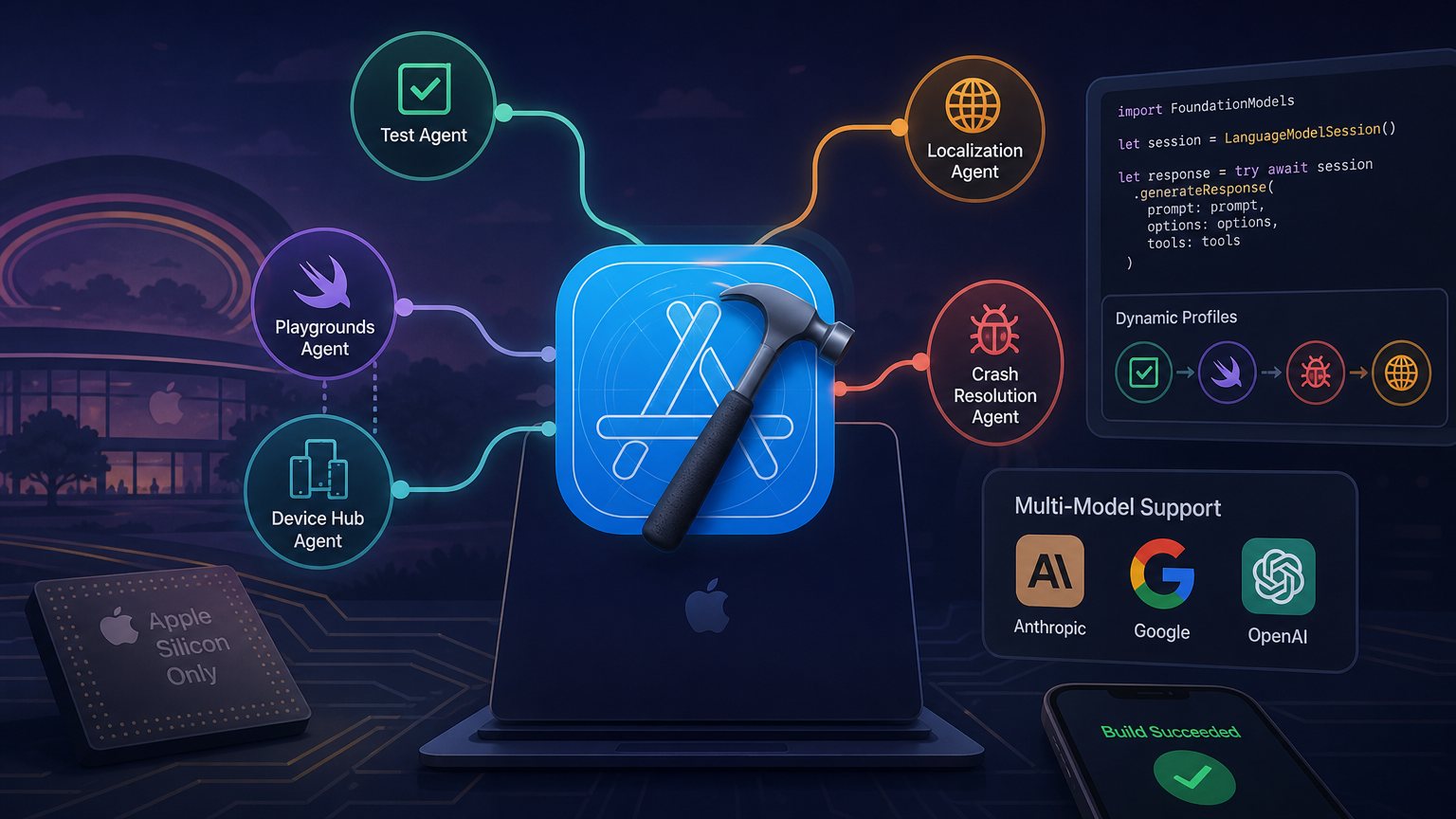
I've watched a lot of WWDC keynotes. Most of them follow the same rhythm: a shiny new OS name, a few UI tweaks, developer deprecation notices buried in the fine print. WWDC 2026, which Apple held on June 9 at Apple Park, was different. The developer story — not the consumer story — was the headline. And the headline is this: Xcode is now an agentic IDE.
That sentence might not sound like much if you've been watching the AI tooling space. GitHub Copilot has had agent modes. Cursor built its whole pitch around it. But when Apple ships something, it ships it at platform scale — with OS integration, hardware optimization, and a mandatory migration path baked in. Xcode 27 isn't a plugin. It's a new model for how Apple developers are expected to work.
What Xcode 27 Actually Does
Let me be specific about the agentic capabilities, because "agentic" has become a word people attach to anything that runs an LLM call.
Xcode 27 ships with agents that can:
- Write and execute test suites autonomously against your code
- Use Swift Playgrounds in isolation to explore and validate ideas before touching your main codebase
- Interact with the new Device Hub — a unified interface replacing the old Simulator manager — to run and introspect builds on both physical devices and simulators
- Localize apps directly, pulling string tables and generating translations without leaving the IDE
- Resolve crash reports pulled from Organizer, automatically correlating logs with source locations and proposing fixes
What makes this agentic rather than just autocomplete is the feedback loop. These agents take actions, observe results, and iterate. A crash-resolution agent isn't just suggesting a fix; it's reading the crash log, identifying the call stack, proposing a patch, building the target, and verifying the crash doesn't repro in the simulator. That's a meaningful workflow change, not a marketing rebrand of tab completion.
The model lineup is notable. Apple didn't pick a single AI partner. Xcode 27 supports Anthropic, Google, and OpenAI models through the same agentic interface. That's a deliberate hedge and an operationally smart one. You're not locked into a single provider's pricing, availability windows, or capability trajectory.
On the hardware side: Xcode 27 is Apple silicon-only. Intel Mac support is gone. The download is 30% smaller, build times are meaningfully faster, and Xcode Cloud achieves up to twice the compilation speed of the previous generation. The Intel break is overdue — most of us migrated years ago — but it's worth noting for any shop still running mixed hardware fleets.
The Foundation Models Framework Is the Real Infrastructure Story
Buried beneath the Siri headlines is the announcement that matters most for developers building AI features: the Foundation Models framework.
Here's what it gives you:
- Free Private Cloud Compute access for apps with fewer than two million first-time App Store downloads. If you're not at massive scale yet, Apple is eating the inference cost.
- Image input support for model inference — visual context passed to on-device models directly from Swift.
- Server-side model integration through a unified Swift API. Claude, Gemini, and other third-party models are first-class citizens — no custom HTTP clients, no managing API keys outside the framework.
- Dynamic Profiles — structured primitives for defining and composing multi-agent workflows in Swift.
There's also an open-source release of parts of the framework scheduled for summer 2026. That's an unusual move from Apple and suggests they're trying to attract community contribution beyond the App Store ecosystem.
The free inference tier for smaller developers is smart platform policy. It lowers the barrier for experimenting with on-device AI features, which grows Apple's AI surface area without requiring every indie developer to sign up for a third-party billing account first. Apple is seeding the platform and betting that developers who build AI features in Foundation Models stay in Foundation Models as they scale.
Core AI: Lower-Level, More Powerful
Alongside Foundation Models, Apple announced Core AI — a lower-level framework for teams with their own trained models who need to deploy them on Apple silicon efficiently. Where Foundation Models is a high-level ergonomic API, Core AI is the plumbing underneath it.
Core AI ships with:
- Ahead-of-time compilation for on-device model inference
- Specialized debugging instruments integrated into Instruments.app
- Python tooling for converting PyTorch models to Apple silicon-optimized formats
The PyTorch conversion path is the piece I find most interesting from an infrastructure standpoint. Most serious ML teams train in PyTorch. Being able to take a trained model and get a production-ready, Neural Engine-optimized build without writing Metal shaders is a meaningful reduction in deployment complexity. This is the kind of work that used to require a dedicated ML platform engineer and days of iteration. Having a CLI workflow for it changes the calculus on what small teams can ship on-device.
SiriKit Is Dead. App Intents Is Mandatory. Plan Accordingly.
The consumer story around Siri was flashy — Apple reportedly licensed a custom 1.2-trillion-parameter version of Google Gemini at roughly $1 billion per year to power the rebuilt assistant. That's a genuine infrastructure commitment and a significant departure from Apple's usual in-house-everything posture. When Apple writes a ten-figure check to a competitor, it's worth taking seriously.
But the migration story is what affects your codebase: SiriKit received a formal deprecation notice at WWDC 2026.
If your app uses SiriKit for voice integration, this is your runway warning. App Intents is now the mandatory surface for Siri integration going forward. The rebuilt Siri uses entity and intent schemas to build a semantic understanding of app content — but that only works if your app exposes its functionality through App Intents. Apps that haven't migrated will lose access to the new conversational capabilities, and eventually lose Siri integration entirely.
Apple also introduced a View Annotations API that lets conversational Siri interactions target and act on on-screen content. Powerful for accessibility and productivity apps — but it only works through App Intents.
If you're shipping an Apple platform app and haven't done the App Intents migration, put it on the roadmap now. The deprecation clock is running and Apple historically doesn't wait long once a formal notice is issued.
What I'm Actually Watching
The crash-resolution and test-writing agent loops in Xcode 27 will have the highest immediate ROI for most teams — not because they're the flashiest features, but because they attack the highest-friction parts of the Apple development cycle. Debugging Organizer crashes and writing test coverage for edge cases eat real hours every sprint. Automating those loops, even imperfectly, compounds over months.
The multi-model architecture is also worth watching beyond convenience. As Anthropic, Google, and OpenAI continue to differentiate on specific task types — code generation, long-context reasoning, structured output — having the IDE support model switching without workflow disruption is a real advantage. Today it's a preference; in 18 months, as model specialization increases, it may be a meaningful productivity lever for teams that pay attention.
The Foundation Models open-source commitment is the wildcard. Apple open-sourcing core AI framework components is essentially unprecedented. If they follow through — and the summer 2026 timeline is close — it could pull significant developer mindshare toward Apple's AI stack in ways that compound well beyond the App Store. I'll believe it when the repos land, but the commitment is notable.
WWDC 2026 was a developer conference that actually moved the ball for developers. That doesn't happen every year. The Xcode 27 agentic layer, the Foundation Models framework, Core AI, and the forced App Intents migration together constitute a platform shift — not a point release. If you ship software for Apple platforms, this week's sessions deserve your time.